
How to Choose a Portable Fire Pump
Davey pumps offered by Darley | Specifications reviewed November 2, 2026
Match the pump to the water you need to deliver, the hose you use, and the way your crew deploys. Learn the basics, work through three examples, and compare Davey models with a clear reason for your choice.
Start Your Selection Check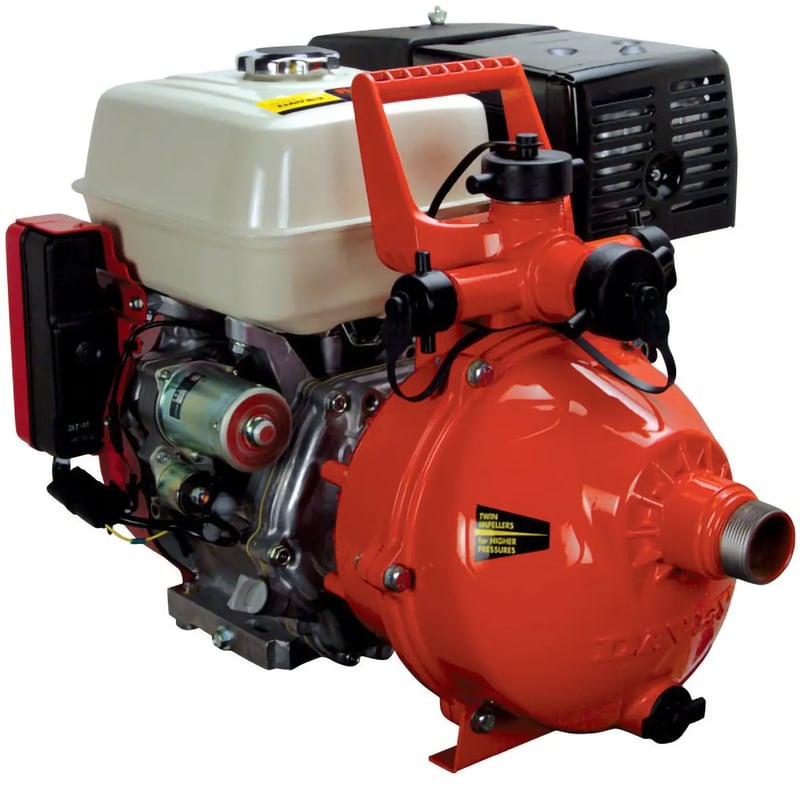
Match flow and pressure
Find a published operating point that supports the water delivery you need.
Check the complete setup
Include the source, hose, fittings, elevation, and installation.
Know what you are ordering
Confirm the engine, starts, weight, connections, and accessories.
Understand what the pump must do
Write down the job before choosing a model: supply a nozzle, fill a tank, transfer water, or equip a skid. The same pump can support several jobs, but each setup has its own flow and pressure requirements.
1. Flow is water per minute
GPM means US gallons per minute. For tank filling, divide gallons to add by the desired minutes. For a nozzle, use the flow specified for that nozzle and operating pressure. Add demands that must run at the same time.
2. Pressure must reach the delivery point
PSI is pressure. The pressure shown at the pump outlet is not automatically the pressure available at a nozzle after the water travels through hose and fittings.
3. Your layout creates losses
Longer hose, restrictions, and an uphill delivery point increase the work required. Obtain hose and fitting losses at the target flow from equipment data or a measured setup.
For a simple discharge line: required pump outlet pressure ≈ delivery pressure + hose friction loss + fitting loss + uphill elevation loss. Account for downhill pressure gain when relevant. This outlet-pressure estimate does not replace checking inlet pressure or suction lift against the pump curve’s test conditions.
Head expresses liquid energy as an equivalent height. For water, about 2.31 feet of head equals 1 PSI. The actual flow settles where the pump capability and system requirement meet. Hydraulic Institute system curve guidance.
Check the water source and installation
Tank supplied
Confirm usable water volume, tank-to-pump plumbing, valves, and inlet conditions. Evaluate the lowest expected tank level as well as the full tank.
Drafting from a static source
Measure vertical lift from the water surface to the pump, not along the hose. Confirm a reinforced suction hose, strainer, airtight connections, and an appropriate source.
Portable or vehicle mounted
Check complete operating weight, actual mounting dimensions, lifting arrangements, controls, battery needs, and access for service.
Inlet thread size is not suction hose sizing. Davey’s manual specifies 1½ inch minimum hose inside diameter for certain smaller engine groups and 2 inch for larger models. Have Darley match that guidance to the exact assembly. Davey manual, installation section.
Read flow and pressure together
On a pump curve, locate the required flow on the horizontal axis, then read the paired pressure on the vertical axis. Compare it with your system requirement at that flow. Check the curve’s engine speed, suction conditions, and operating limits before making the final selection.
AK306 example: four published operating points
The bars below compare pressure at four listed flows. They do not reproduce the complete pump curve or estimate values between points.
Read the highlighted point: 60 GPM is paired with 133 PSI at the pump under the stated rating conditions. Hose losses still reduce the pressure available farther down the line.
Open the manufacturer’s AK306 performance curve PDF · View the published AK306 operating points
Do not combine separate maxima. The AK306 listing pairs 120 GPM with 40 PSI and 20 GPM with 146 PSI. It does not establish 120 GPM at 146 PSI. The full curve is also needed when your target falls between the listed points.
Work through three selection examples
These are hypothetical buying exercises. Flow demands, losses, allowances, and layouts are explicitly assumed; replace them with your equipment data. A shortlist still needs confirmation against the exact curve and installation.
Example 1: Fill a 600 gallon tank in 10 minutes
Assumptions: 600 gallons to add; 10 minutes of pumping; a verified transfer layout requiring 40 PSI at 60 GPM; inlet conditions matching the pump rating. Setup time is excluded.
Calculate: 600 ÷ 10 = 60 GPM minimum. You therefore need to verify at least 60 GPM at the 40 PSI system requirement.
Shortlist: AK314 and AK315 list 65 GPM at 48 PSI, supporting further evaluation for this assumed duty. Their different starting arrangements let you compare electric versus manual start.
Before choosing: confirm the actual operating point and acceptable continuous engine speed. Do not assume a catalog point at one speed guarantees the desired fill time at a reduced operating speed. If the layout needs much more pressure, this shortlist may change.
Example 2: Supply one 60 GPM nozzle
Assumptions: a nozzle specified for 60 GPM at 50 PSI; 200 feet of 1½ inch discharge hose on level ground; hypothetical hose loss of 30 PSI and fitting loss of 10 PSI at 60 GPM; inlet conditions matching the pump rating. The loss values are teaching inputs, not a universal hose chart.
Calculate: 50 + 30 + 10 = 90 PSI at the pump outlet at 60 GPM.
Shortlist: AK308 lists 60 GPM at 105 PSI, giving a nominal 15 PSI difference from the assumed requirement. AK301 and AK313 list 60 GPM at 118 PSI; AK306 lists 60 GPM at 133 PSI. Each warrants evaluation against the actual setup.
Why another model needs closer checking: the 6.5 HP listing’s 50 GPM at 81 PSI does not establish the required 60 GPM at 90 PSI. Obtain its complete curve rather than inferring suitability from horsepower or maximum pressure.
Before choosing: substitute measured or manufacturer hose losses, account for any elevation or additional outlets, and verify operating reserve and nozzle pressure control with Darley.
Example 3: Fit a pump package within a UTV allowance
Assumptions: 100 lb remains for the pump package after separately accounting for occupants, full water tank, and all other vehicle loads. Allow 25 lb for items beyond the listed pump weight, such as fuel, battery if needed, mount, and accessories. This allowance must be replaced with actual weights.
Calculate: a listed 60 lb pump + 25 lb = 85 lb; an 80 lb pump + 25 lb = 105 lb; a 92 lb pump + 25 lb = 117 lb.
Shortlist: AK314 and AK315 pass this illustrative weight screen; the heavier examples exceed it. This is not yet a hydraulic selection.
Before choosing: confirm the full package weight, payload and axle limits, mounting dimensions, and water delivery requirement. If the lighter pump cannot meet the required duty, revise the vehicle/package plan.
Compare Davey portable pumps
Use these tables to build a shortlist. Product names retain Darley’s published horsepower labels. Confirm the engine, starting package, weight basis, and mounting arrangement on the quote.
| Model | Engine | Starting | Listed pump weight | What to compare |
|---|---|---|---|---|
| AK315 | 6.5 HP Honda | Manual | 60 lb | Compare when carrying weight and manual starting matter. |
| AK314 | 6.5 HP Honda | Electric | 60 lb | Compare with AK315 when electric starting is preferred. |
| AK308 | 9 HP Honda GX270 | Electric and recoil | Approx. 80 lb | Compare its pressure at your required flow with the 6.5 HP options. |
| AK301 | 10 HP Briggs & Stratton Vanguard | Electric and recoil | Approx. 80 lb | Gasoline alternative with a different published flow and pressure profile. |
| AK313 | 10 HP Yanmar diesel | Electric and recoil | Approx. 80 lb | Compare when diesel fuel aligns with your fleet. Verify assembly dimensions and weight. |
| AK306 | 13 HP Honda GX390 | Confirm supplied configuration | 92 lb | Compare when more pressure is needed at the listed flows; check the heavier package. |
| Model | Published operating points |
|---|---|
| AK315 | 65 GPM at 48 PSI; 50 GPM at 81 PSI; 20 GPM at 120 PSI |
| AK314 | 65 GPM at 48 PSI; 50 GPM at 81 PSI; 20 GPM at 120 PSI |
| AK308 | 120 GPM at 10 PSI; 95 GPM at 55 PSI; 60 GPM at 105 PSI; 20 GPM at 125 PSI |
| AK301 | 120 GPM at 36 PSI; 95 GPM at 83 PSI; 60 GPM at 118 PSI; 20 GPM at 144 PSI |
| AK313 | 120 GPM at 36 PSI; 95 GPM at 83 PSI; 60 GPM at 118 PSI; 20 GPM at 144 PSI |
| AK306 | 120 GPM at 40 PSI; 95 GPM at 108 PSI; 60 GPM at 133 PSI; 20 GPM at 146 PSI |
The AK313 shop listing identifies the product as AK313 but labels its physical specification section AK301. Obtain confirmed dimensions and complete package weight before designing a mount. GPM and PSI are retained here because some source metric conversions are inconsistent.
Build the complete pump package
- Water intake: reinforced suction hose of the required inside diameter, compatible fittings, strainer, and source arrangement.
- Discharge: hose, nozzle, valves, and adapters matched to the required pressure and flow. Check working pressure ratings.
- Threads: the Darley listings show 1½ inch male NPT suction, one 1½ inch male NPT discharge, and two 1 inch male NPT outlets. Specify adapters to your hose couplings.
- Starting and installation: confirm battery and leads where applicable, mount or protective frame, access, and complete transport weight.
- Ownership: manuals for the exact pump and engine, maintenance supplies, fuel plan, and service/parts contacts.
Confirm your selection before ordering
Complete this worksheet with your crew or Darley representative. An unknown answer identifies what to resolve next; it does not count as a passed check.
| Check | Record your requirement | What confirms the choice |
|---|---|---|
| Application | Job and simultaneous demands: __________ | The stated duty matches the way the pump will be used. |
| Water delivery | Required GPM: ____; delivery PSI: ____ | Nozzle/equipment data or target tank fill time. |
| System requirement | Hose: ____; fittings: ____; elevation: ____ | Documented losses at the target flow and the resulting pressure requirement. |
| Water source | Tank/draft: ____; lift/inlet conditions: ____ | Suction arrangement and source conditions checked against the rating conditions. |
| Selected model | SKU/engine: ____; curve/date: ____ | The exact curve supports the required duty with appropriate operating reserve. |
| Installation | Complete weight: ____; space/mount: ____ | Confirmed assembly dimensions, payload, and access. |
| Package | Included items: ____; items to add: ____ | Hose, threads, ratings, accessories, and starting equipment match. |
| Final confirmation | Reviewed with: ____; open questions: ____ | Conflicting specifications resolved and the final configuration recorded. |
Explain your choice in one sentence
“We selected ______ because it supports ______ GPM at our required ______ PSI under the confirmed source conditions, fits our installation, and includes ______.”
If you cannot fill in those blanks, send the worksheet details to Darley before placing the order.
Get help confirming your pump setup
Share the nozzle model, target flow, hose length and diameter, elevation, water source, and mounting limits. Ask for the exact pump configuration, performance curve, and a complete equipment quote.
Davey pump support: 319-987-2121
Keep the selected pump ready
Use the instructions supplied with the exact pump and engine. Fill the casing before priming, check airtight suction connections, maintain water flow during operation, and drain for freezing conditions. Confirm the permitted engine speed for continuous transfer work. Read the Davey installation and operating manual.
Questions customers ask
Can I choose a portable pump by horsepower?
Use horsepower to identify an engine option, then compare the pump’s flow at the pressure your system requires. Engines with similar horsepower can be paired with different pump designs.
Does maximum GPM happen at maximum PSI?
No. Those values describe different operating points. Read the flow and pressure together on the exact model’s performance curve.
How much pressure do I need at the pump?
For a simple single discharge line, start with required delivery pressure and add hose friction, fitting losses, and uphill elevation loss at the target flow. Inlet conditions and more complex layouts also need to be checked.
Does self priming mean I can start with an empty pump?
No. Prepare the casing and suction system as directed in the supplied pump manual before starting.
Is a 1½ inch inlet a recommendation for 1½ inch suction hose?
No. The threaded connection size and recommended hose inside diameter are different specifications. Confirm suction hose sizing for the exact engine and pump configuration.
Which Davey pump is best for a UTV?
First check the hydraulic requirement, then verify the remaining payload, full operating weight, mounting dimensions, and controls. A pump that fits the weight allowance may still fail to meet the water delivery requirement.
What if I do not know the hose loss or required pressure?
Send Darley the nozzle model, desired flow, hose diameter and length, elevation change, water source, and intended mounting arrangement. Ask for a documented model and package recommendation.
How do I confirm my selection before ordering?
Obtain the exact model curve and rated conditions, resolve missing specifications, confirm the complete package and installation fit, and retain a written explanation of why the selected pump meets your requirements.
Technical references and support
Confirm the exact configuration and current specifications before ordering. Use this selection guide alongside manufacturer instructions and department procedures.