
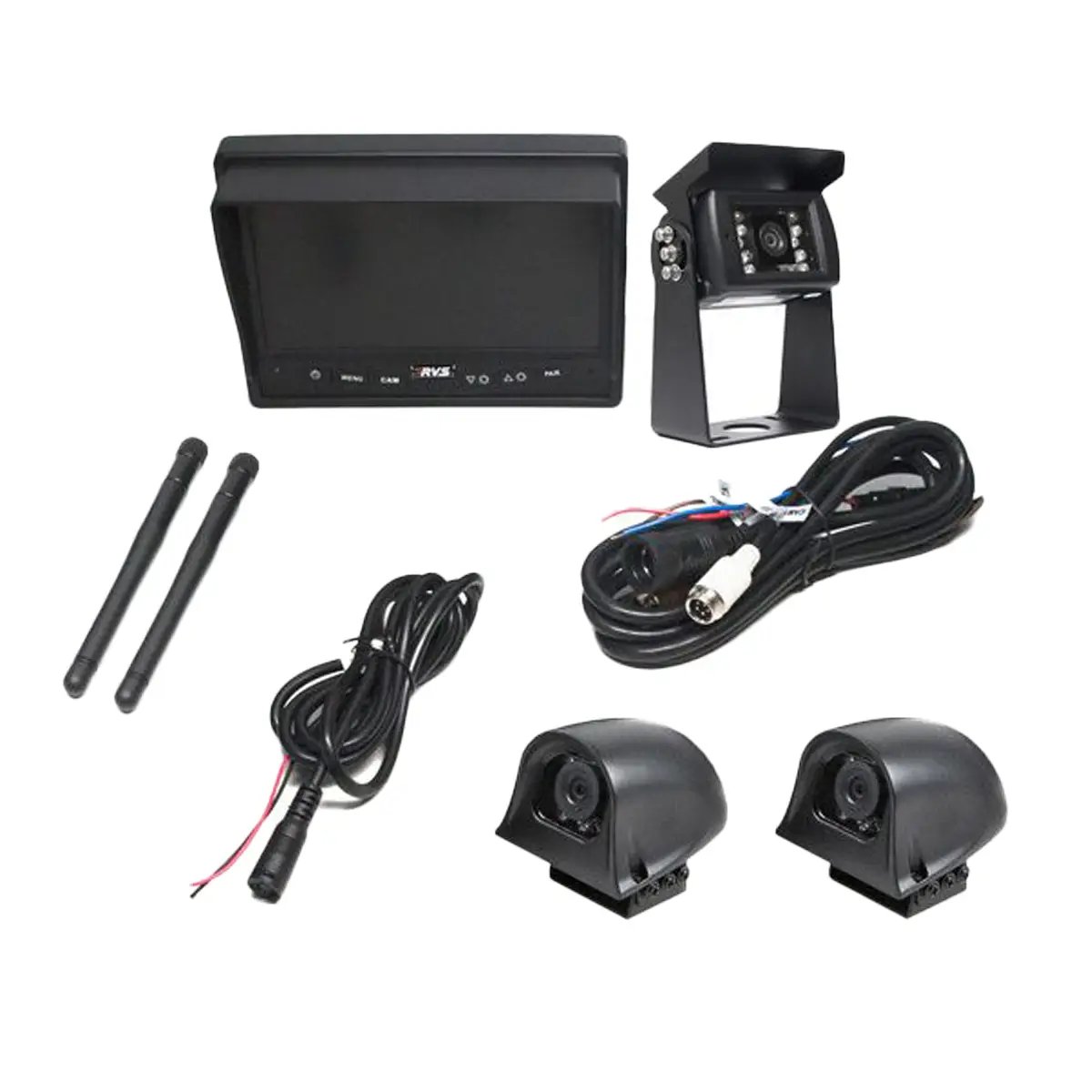
Wireless Backup Camera System with 7" HD Monitor (3-Channel)
SKU#: BL698
Ships via Standard Ground
Typically ships in 2 weeks
The SIMPLE SIGHT™ RVS‑355W‑HD wireless backup camera system delivers HD visibility, long‑range wireless performance, IP69K durability, and night‑vision capability, making it ideal for first responders and fleet safety operations.
Looking for a quote? Simply add your items to the cart and choose Request for Quote during checkout.
Enter a value between 1 and 100000000 in increments of 1.
Earn Darley Dollars with this purchase
Features
- Brighter HD Display: 7" LED digital panel with higher resolution for improved clarity.
- Long‑Range Wireless Transmission: Guaranteed 100ft+ signal strength, even at highway speeds.
- IP69K Waterproof Cameras: Withstands harsh weather and includes 120° viewing angle and night vision up to 15 ft.
- Vibration + Shock Resistant: Engineered for commercial and industrial environments.
- Instant Pair Technology: Pair cameras and monitor in under one minute without leaving the cab.
- Flexible Mounting Options: Includes both adhesive and suction cup mounts.
- Furrion® Bracket Compatibility: Includes adapter for vehicles with Furrion® pre‑wire kits.
- Automatic Triggering: View changes with turn signals and reverse activation.
What Is It?
The SIMPLE SIGHT™ RVS‑355W‑HD is a 3‑channel wireless backup camera system featuring a 7" HD monitor, one wireless rear camera, and support for two additional wired side cameras. The system is designed to provide clear rear and side visibility, even in demanding environments such as emergency response, commercial fleets, and towing operations.
How Is It Used?
This wireless system is installed on a vehicle (truck, emergency apparatus, trailer, etc.) to provide real‑time visual monitoring behind and beside the vehicle. The monitor automatically switches views using turn signals or reverse gear. The wireless rear camera simplifies installation on trailers, while side cameras are hard‑wired for immediate directional visibility.
Who Uses It?
The RVS‑355W‑HD is suited for:
- First Responders (fire apparatus, ambulances, rescue trucks)
- Commercial Fleet Operators
- Utility and Construction Vehicles
- Towing and Trailer Haulers
These users benefit from improved situational awareness, accident prevention, and visibility during night operations.
What Is It Used With?
- Vehicles equipped with Furrion® pre‑wire kits (adapter included).
- Two optional wired side cameras (compatible with the monitor’s wired inputs).
- 12V–36V DC vehicle power systems.
Maintenance Information
- Clean lenses regularly with a non‑abrasive cloth to maintain image clarity.
- Ensure antenna on monitor remains upright for optimal transmission.
- Check wiring and mounting brackets periodically for security, especially in high‑vibration environments.
- Avoid high‑pressure washing directly onto the camera; although IP69K‑rated, excessive force can shorten component life.
Installation Steps
- Mount the Monitor in the Cab
- Choose either the adhesive mount or suction cup mount included with the system.
- Ensure the monitor’s antenna is installed pointing straight up for optimal wireless transmission.
- Provide Power to the Monitor
- Connect the monitor to a DC 10–36V power source, per its required input range.
- Install the Wireless Backup Camera
- Mount the IP69K‑rated camera at the rear of the vehicle or trailer using the integrated bracket.
- Connect the camera to a DC 10–36V power supply, as wireless refers only to signal transmission, not power.
- Install Optional Wired Side Cameras
- The system supports two wired side cameras, which can be mounted on the left and right sides of the truck or vehicle.
- Connect each camera to the corresponding wired video inputs on the monitor.
- Pair the Wireless Camera Using Instant Pair
- Power on the system.
- Use the Instant Pair feature to sync the monitor and wireless camera in under one minute, without leaving the cab.
- Integrate Turn Signal & Reverse Triggers (If Vehicle Allows)
- When wired correctly, the monitor will automatically switch to:
- Left/Right camera views when turn signals are active.
- Backup camera view when in reverse.
- Optional: Use the Furrion® Pre‑Wire Adapter
- For vehicles equipped with a Furrion® mount, attach the included adapter to install the camera cleanly on the existing bracket.
- Note: The 12V power adapter may not be compatible with all Furrion® brackets.
- System Test & Final Adjustments
- Turn on the display and verify video feed from all installed cameras.
- Adjust camera angles to ensure the 120° field of view effectively covers blind spots.
- Confirm stability of the signal at various distances (up to 100+ ft, even at highway speeds).
Monitor
- Screen Size: 7" LED digital panel
- Resolution: 1024 × 3 (RGB) × 600
- Brightness: 450 cd/m²
- Contrast Ratio: 500:1
- Aspect Ratio: 16:9
- Video Inputs: 3 (1 wireless, 2 wired)
- Transmitting Distance: 100 ft (open area)
- Power Supply: DC 10–36V
- Operating Temp: –20°C to +65°C
- Dimensions: 7" (L) × 5" (H) × 1" (D)
Camera
- Image Sensor: 1/3" color
- Active Pixels: 1292 × 968
- Waterproof Rating: IP69K
- Viewing Angle: 120°
- Night Vision: 15 ft (approx. 5m)
- Transmitting Distance: 100 ft (open area)
- Power Supply: DC 10–36V
- Operating Temp: –20°C to +65°C
- Model: RVS-355W-HD