
FSI
FSI® Portable Mass‑Casualty Decontamination Showers
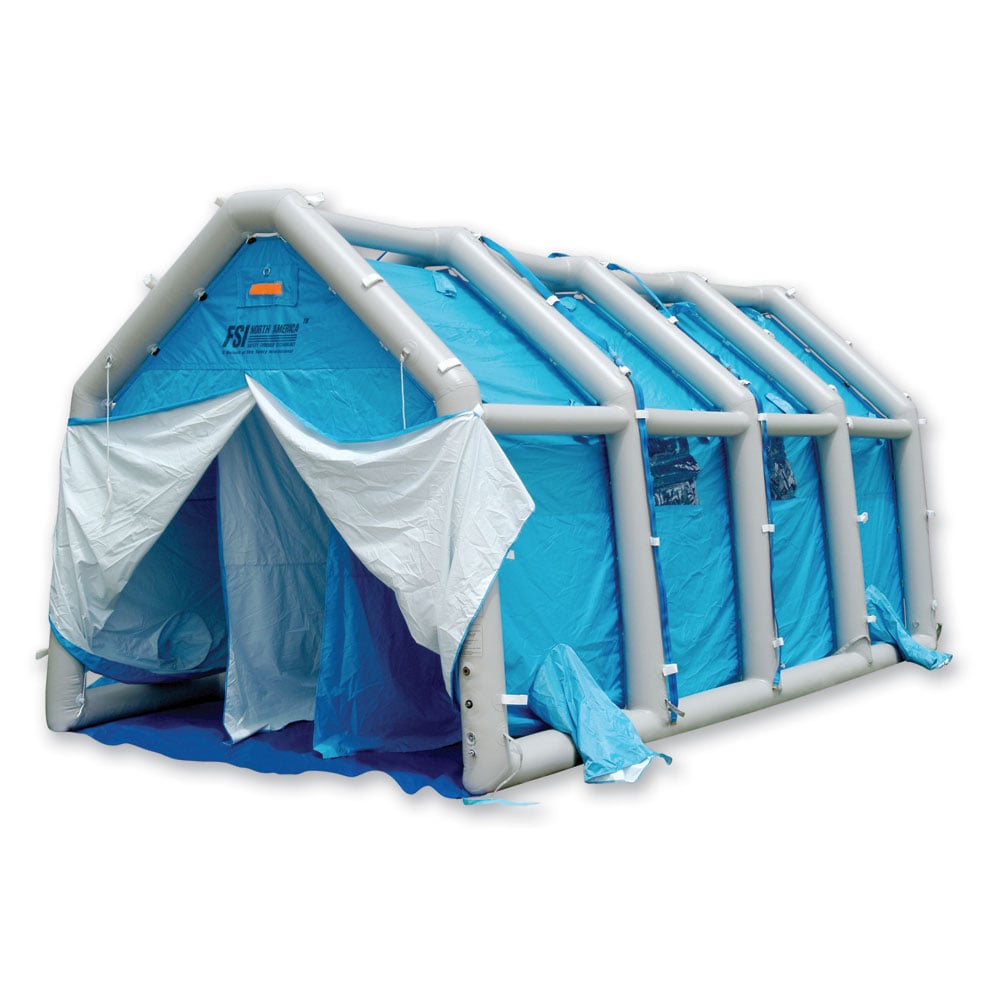
FSI® DAT‑Series Mass Casualty Decontamination Showers provide fast‑deploy, high‑performance decon solutions for first responders handling chemical, biological, or radiological incidents. The compact, two‑line DAT®3030S and the high‑capacity, four‑line DAT®4070S both feature durable air‑berm construction, integrated containment floors, and multi‑stage washdown capability—supporting rapid, efficient decontamination for both ambulatory and non‑ambulatory patients in demanding field environments.
Looking for a quote? Simply add your items to the cart and choose Request for Quote during checkout.
Enter a value between 1 and 100000000 in increments of 1.
Earn Darley Dollars with this purchase
Rapid‑deploy, ANSI/ISEA 113–compliant systems for firefighter, HazMat, EMS, hospital, and military CBRN response. Both models are suitable for gross decon per NFPA 1851 practices immediately after fireground operations.
Why Choose FSI® DAT‑Series Decon Showers
- Under‑minutes deployment: Inflates and goes operational quickly (model/method dependent).
- Potable‑water hose systems: Polyurethane hoses (NSF/ANSI 61) are suitable for direct contact during decon.
- Heavy‑duty air‑berm construction: 1100 Dtex, UV/chemical‑resistant materials with quadruple‑overlapped, glued seams.
- Built‑in compliance: ANSI/ISEA 113; suitable for NFPA 1851 gross‑decon workflows.
- Scalable: Attach additional shelters and add heaters, detergent injectors, pumps, lighting, and manifolds as needed.
Which Model Is Right for You?
DAT®3030S — 2‑Line Decon Shower (3‑Stage)
- Best for: Compact footprints, smaller teams, quick drills, rapid initial set‑ups
- Throughput: 2 non‑ambulatory or up to 4 ambulatory simultaneously (or mixed)
- Setup time: ~1–2 minutes
- Footprint & weight: ~10′ W × 10′ L × 9′ H (≈100 sq ft); ≈139 lb
- Key highlights: Waterproof, reusable system with integrated containment floor (~200 gal), ~12 fixed heads + (4) handheld spray guns, ¾″ GHT water inlet
DAT®4070S — 4‑Line Decon Shower (3 or 4 Stage)
- Best for: High‑throughput incidents, multi‑agency surge operations, large events
- Throughput: 4 non‑ambulatory or up to 8 ambulatory simultaneously (or mixed)
- Setup time: Under 3 minutes
- Footprint & weight: ~14.5′ W × 23′ L × 9′ H (≈330 sq ft); ≈340 lb
- Key highlights: Four parallel lanes with undress → detergent → rinse → redress, integrated containment floor (≈450 gal), 24 fixed heads + 12 handheld spray guns, dual ¾″ GHT inlets
Side‑by‑Side Overview
Lines & Stages
- DAT®3030S: 2 lines, 3‑stage (undress → shower → rinse/redress)
- DAT®4070S: 4 lines, 3 or 4 stages (undress → detergent → rinse → redress)
Throughput
- DAT®3030S: 2 non‑ambulatory or up to 4 ambulatory
- DAT®4070S: 4 non‑ambulatory or up to 8 ambulatory
Containment Capacity
- DAT®3030S: ≈200 gallons integrated floor before pump‑out
- DAT®4070S: ≈450 gallons integrated floor before pump‑out
Spray Hardware
- DAT®3030S: ~12 fixed heads + (4) handheld spray guns; plan ≈1 gpm per outlet (supply dependent), with typical system planning up to ~8 gpm
- DAT®4070S: 24 fixed heads + 12 handheld spray guns; shutoffs and quick‑disconnects grouped for control
Water Connection
- Both models: ¾″ GHT threaded inlets to pressurized supply
What’s Included
All DAT‑series systems arrive mission‑ready with:
- Inflation hardware (electric inflator/deflator, inflation hose, pressure‑relief valve, high‑/low‑pressure valves; SCBA inflation fitting)
- Divider curtains (center and cross‑dividers) to manage lanes and privacy
- Dirty‑entry / clean‑exit doors for one‑way traffic and contamination control
- Windows & skylights for visibility and oversight
- HVAC/air‑duct inlets & vents for airflow and clothing/gear transfer
- Integrated containment floor (bermed) with reflective markings
- Anchoring kit (stakes, ropes, D‑rings, hammer)
- Potable‑water hose systems (NSF/ANSI 61)
- Repair kit, manual, and shelter sleeve/carry bag
- For model‑specific counts and dimensions, see each product detail page.
Deployment Workflow (Common to Both)
- Stage & inflate on level ground; connect air or use the electric inflator/deflator.
- Hook up water via 3/4″ GHT; verify flow at fixed heads and handheld guns.
- Control traffic from dirty entry → showers → rinse → clean exit using included dividers and doors.
- Manage wastewater by pumping out the integrated floor as it approaches capacity.
Frequently Asked Questions
- Do the hose systems meet potable‑water standards?
- Yes—polyurethane hoses used in these systems meet NSF/ANSI 61 for potable water.
- How should we plan water supply?
- Plan for approximately 1 gpm per active outlet (supply dependent). For the DAT®3030S, planning up to ~8 gpm total is common. Larger systems scale accordingly.
- Are these shelters stable outdoors?
- Yes. When tied down/staked per instructions, they are engineered for high‑wind operation and harsh environments.
DAT®3030S
- Max System Flow: Up to approximately 8 gpm total (water‑supply dependent).
- Water Connection: 3/4″ GHT female inlet.
- Spray Head Material: Nylon (per common supplier listings).
- Shell/Frame Materials: PVC/nylon outer materials with plastic frame elements.
- Country of Origin: USA (as listed by multiple distributors).
- Shipping Dimensions: Approximately 52″ L × 43″ W × 27″ H.
DAT®4070S
- Total Stations & Hardware: Four stations equipped with 24 fixed spray heads and 12 handheld spray guns with group shutoffs.
- Containment Capacity: Integrated floor holds approximately 450 gallons before pump‑out.
- Water Connection: Dual 3/4″ GHT female inlets.
- Spray Head Material: Steel/brass (as listed by major industrial suppliers).
- Shipping Dimensions: Approximately 54″ L × 43″ W × 36″ H.